Understanding sourdough starter microbiology transforms you from a baker who follows recipes into one who genuinely understands what happens inside your jar. Most home bakers feed their starters on schedule without grasping the biological mechanisms at work. Yet the microbes responsible for fermentation—wild yeasts and lactic acid bacteria—follow predictable patterns once you know what to observe. This knowledge empowers you to troubleshoot problems, optimise feeding schedules, and consistently produce better bread.
At its core, a sourdough starter is a stable ecosystem containing two primary microorganisms: Saccharomyces cerevisiae and wild Lactobacillus species (commonly Lactobacillus plantarum). These organisms coexist in a symbiotic relationship where bacteria produce acids that create an environment favourable for yeast growth, whilst the yeast produces compounds that support bacterial survival. When you feed your starter with flour and water, you’re essentially providing a food source and maintaining conditions that allow these microbes to thrive and multiply. Understanding this relationship—and the environmental factors that influence it—gives you genuine control over your fermentation process.
The Microbial Cast: Yeasts and Bacteria in Your Starter
Your starter harbours a surprisingly complex microbial community, though a handful of species dominate the ecosystem. Wild yeasts—predominantly Saccharomyces cerevisiae—are responsible for leavening your bread. These single-celled fungi consume sugars through a process called fermentation, producing carbon dioxide and ethanol as byproducts. The carbon dioxide creates the rise, whilst the ethanol contributes subtle flavour notes and aids dough conditioning.
Lactic acid bacteria, particularly Lactobacillus plantarum and Lactobacillus brevis, produce lactic and acetic acids through their own fermentation pathways. These acids serve multiple purposes: they lower the pH of the dough (making it more acidic), which strengthens gluten development and extends shelf life. The acids also contribute the distinctive tangy flavour associated with sourdough bread. Interestingly, the ratio of lactic to acetic acid varies depending on fermentation temperature and duration. Cooler, longer fermentations favour acetic acid production, resulting in sharper, more pronounced sourness.
The relationship between these organisms is genuinely symbiotic. Lactobacilli produce compounds that suppress the growth of unwanted microbes, creating a protective environment for the desirable yeast population. Meanwhile, the yeasts metabolise compounds that bacteria cannot easily digest, creating a food source that keeps the bacterial population active. This mutual dependency is why a healthy starter remains stable across months and years—the microbes regulate one another naturally.
Wild Yeasts Versus Commercial Yeasts
Commercial baker’s yeast (Saccharomyces cerevisiae) and wild yeast strains are genetically similar but differ significantly in their fermentation characteristics. Commercial yeast is highly predictable: it ferments rapidly at warm temperatures and produces minimal acids. Wild yeasts adapted to your local environment ferment more slowly and less uniformly, but they develop more complex flavours over extended fermentation periods. Your starter may contain multiple yeast species alongside Saccharomyces cerevisiae—Pichia, Candida, and Torulaspora species frequently appear in mature starters. These minority populations contribute subtle flavour compounds even though they don’t produce significant leavening power. This microbial diversity, difficult to replicate with commercial yeast alone, is why naturally fermented sourdough develops flavour complexity that pure baker’s yeast cannot match.
How Temperature Shapes Microbial Activity
Temperature fundamentally controls which microbes thrive in your starter. Both yeast and bacteria have optimal temperature ranges where they reproduce most vigorously. Understanding these ranges allows you to manipulate your starter’s behaviour deliberately.
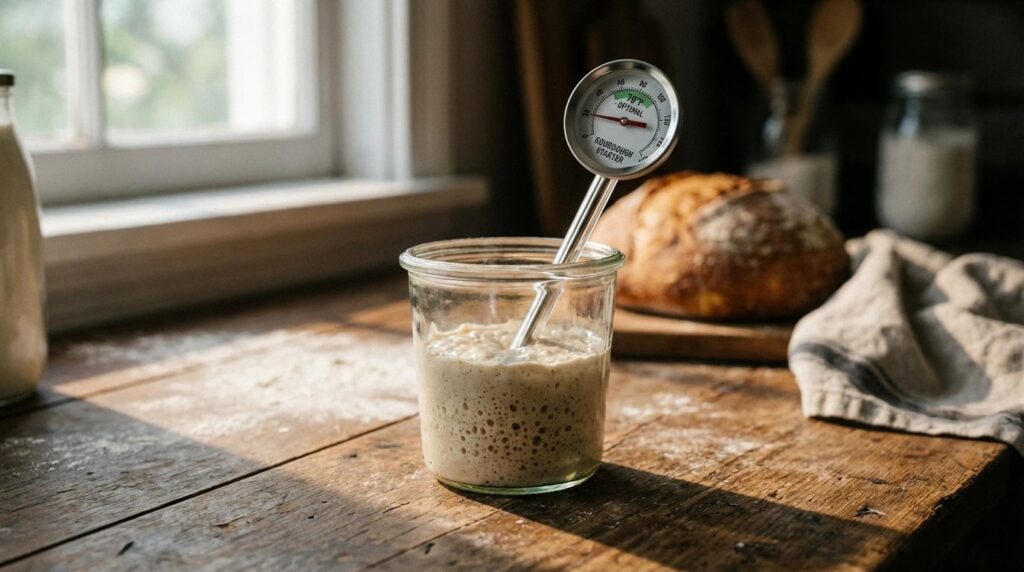
Saccharomyces cerevisiae performs optimally between 20–25°C, fermenting steadily and producing minimal acids. At this temperature range, the yeast grows faster than the bacteria, resulting in a starter that rises predictably and tastes mildly sour. When temperatures drop to 15–18°C, fermentation slows dramatically. The yeast’s metabolic rate declines, but the bacteria remain relatively active—consequently, you develop higher acid levels and sharper flavour despite slower rising times.
Cold temperatures below 10°C effectively pause fermentation. Microbes become metabolically dormant, which is why you can refrigerate your starter for weeks without feeding. However, complete microbial shutdown doesn’t occur until freezing point. Between 0–10°C, slow fermentation continues; you might notice a grey liquid (hooch) accumulating above the starter, which is alcohol produced by sluggish yeast fermentation.
Warmth above 30°C accelerates everything—yeast and bacteria multiply rapidly, consuming nutrients quickly. Your starter peaks and declines faster at warm temperatures, which is why consistent feeding schedules are critical during summer months. Above 40°C, heat begins damaging microbial cells. Beyond 50°C, most Lactobacillus species die, which is why vigorous boiling sterilises containers.
Leveraging Temperature for Consistent Results
Professional bakers exploit temperature control to achieve reproducible fermentation timescales. If your kitchen fluctuates between 18–24°C seasonally, your starter’s activity patterns will shift accordingly. A useful practice involves maintaining a log of ambient temperature alongside your feeding schedule and the time your starter takes to double. After several weeks, patterns emerge: you’ll notice precisely how many hours your starter requires to peak at different temperatures. This empirical knowledge lets you time your bulk fermentation and shaping to avoid overproofing regardless of seasonal variations.
Fermentation Chemistry: From Flour to Flavour
The chemical transformations occurring in your starter are remarkably elegant. When you feed with flour and water, you’re providing carbohydrates (starches and simple sugars) and proteins. The microbes convert these raw ingredients into compounds that fundamentally alter dough behaviour and bread quality.
Yeasts metabolise simple sugars primarily through alcoholic fermentation, producing ethanol and carbon dioxide. Bacteria use multiple pathways simultaneously: homofermentative bacteria (like Lactobacillus plantarum) convert sugars directly into lactic acid, whilst heterofermentative bacteria (like Lactobacillus brevis) produce both lactic and acetic acids alongside other compounds. This metabolic diversity explains why sourdough develops complex flavours: the byproducts of bacterial metabolism include esters, aldehydes, and organic acids that contribute subtle fruity, nutty, or acidic notes.
Proteolysis—the enzymatic breakdown of proteins—occurs alongside fermentation. Bacteria produce proteases that break protein chains into amino acids and smaller peptides. These breakdown products serve multiple purposes: they provide nutrients that sustain the microbial population, they enhance dough extensibility (making it easier to shape), and they contribute umami-like savoury flavours to the finished bread. This is why long fermentations produce more tender crumbs and deeper flavours than short fermentations: the extended time allows bacterial enzymes to work more thoroughly.
The Role of Enzymatic Activity
Your flour itself contains enzymes—amylases break starch into sugars, and proteases begin breaking proteins. Fermentation temperatures accelerate enzyme activity (within limits). Cooler fermentations favour amylase activity, producing more fermentable sugars and potentially extending the final proof time. Warmer fermentations accelerate protease activity, weakening gluten structure faster. Consequently, a cool-fermented dough requires longer rising times but develops more intricate flavour than a warm-fermented dough of equivalent age.
Reading Your Starter: Observable Signs of Microbial Health
A healthy starter displays predictable, observable behaviour that reveals its microbial composition and activity level. Learning to read these signs lets you assess starter condition without relying on timers or assumptions.
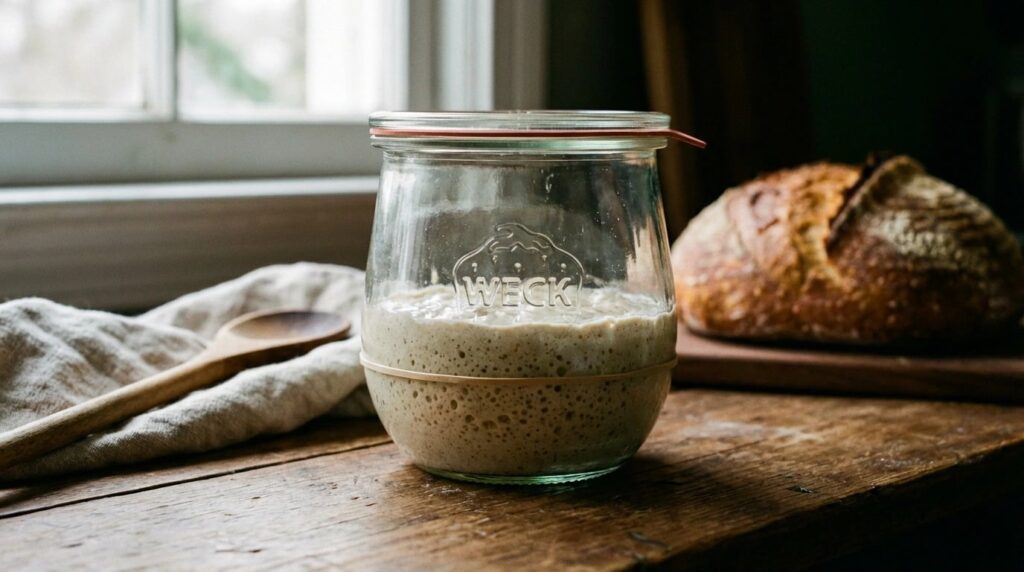
Rising activity is the most visible sign. Between 4–8 hours after feeding (at room temperature around 22°C), a healthy starter should begin expanding visibly. You’ll observe bubbles throughout the mixture and a dome forming at the surface. The volume typically doubles within 8–12 hours. This rising indicates vigorous yeast activity: the microbes are fermenting sugars and producing gas. Slower or absent rising suggests either underpopulated yeasts, insufficient food, or temperatures below the yeast’s optimal range.
Smell offers another diagnostic clue. A pleasant, mildly acidic aroma indicates healthy bacterial activity. Some starters develop fruity or yoghurt-like notes, signalling the presence of diverse microbial byproducts. Unpleasant smells—rotten eggs, nail polish, or vinegar-like pungency—suggest contamination or severe acid imbalance. A very sharp, pungent smell from a starter that’s otherwise healthy usually indicates excess acetic acid production, common in cool fermentations or underfeeding scenarios. This starter may still be viable; feeding more frequently (or at warmer temperatures) typically restores balance.
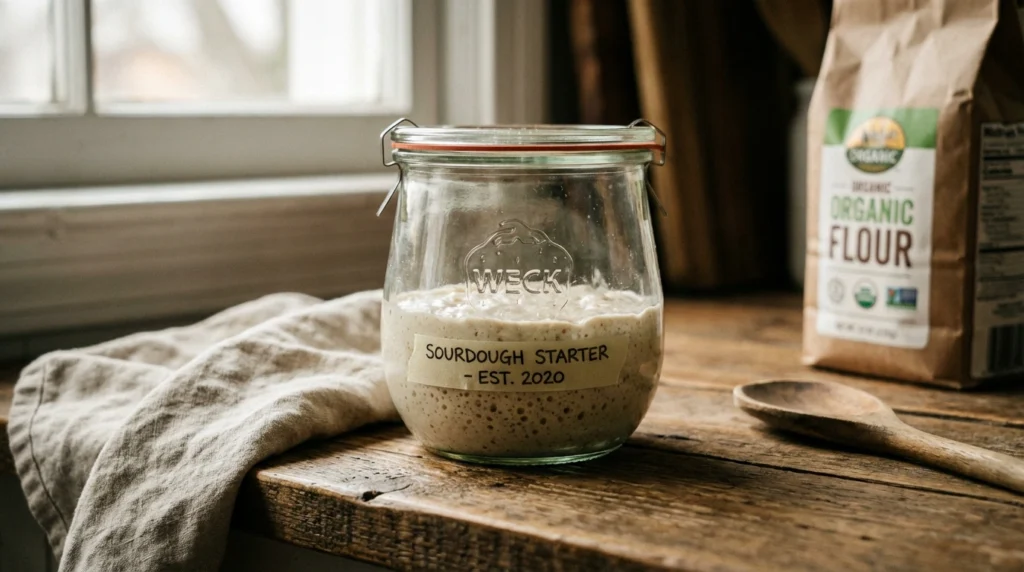
Texture and consistency matter too. A healthy starter contains a network of fine bubbles distributed throughout, creating a foamy appearance. The mixture should smell pleasantly fermented and appear lighter in colour than freshly mixed flour and water. A starter that separates into a distinct liquid (hooch) atop a denser paste suggests the yeast has fermented available sugars faster than the bacteria, leaving excess liquid. This is normal and indicates the starter is ready for feeding; the liquid itself is safe—it’s just water containing yeast metabolites.
Recognising Peak Readiness
Determining when your starter has peaked—reached maximum rising and fermentation—is crucial for consistent bread. Most bakers watch for the doubling point, but microbiology reveals a more nuanced picture. A truly peaked starter has risen maximally but hasn’t yet begun collapsing. The surface appears slightly domed and bubbly. If the dome flattens or the mixture begins receding, the yeast has consumed most available sugars and is becoming dormant. Using starter at this decline point produces slower fermentation in your dough because the yeast population is less vigorous.
A practical approach involves feeding your starter at a consistent ratio (for example, 1:1:1 by weight—starter, flour, water) and observing how long it takes to peak in your kitchen’s ambient temperature. Record this timeframe. Subsequently, you can time your feeding to ensure your starter peaks when you plan to mix dough, eliminating guesswork and ensuring maximum leavening power.
Optimising Your Feeding Schedule Through Microbiology
Once you understand microbial metabolism, feeding schedules become logical rather than arbitrary. The fundamental principle is simple: maintain nutrient availability and remove fermentation byproducts regularly enough to prevent microbial stress, but infrequently enough to allow flavour development.
Daily feeding (typical for starters kept at room temperature) sustains a large yeast population optimised for rapid fermentation. The frequent nutrient replenishment supports vigorous fermentation, resulting in a starter that doubles reliably within 4–8 hours. However, daily feeding doesn’t develop strong acidic character because bacteria never accumulate high population densities—they’re constantly diluted by fresh feeding.
Reduced feeding schedules—feeding every other day or twice-weekly—allow bacterial populations to expand. Between feedings, bacteria acidify the starter, developing tangier flavour. The yeast population becomes smaller relative to bacteria, which actually strengthens your bread’s flavour complexity and extends shelf life (higher acidity preserves crumb freshness longer). The tradeoff is less predictable rising times: a starter maintained on sparse feeding schedule may take 12–18 hours to peak rather than 8 hours.
Professional bakers often use the ratio-based approach: feed at specific weight ratios (1:2:2 or 1:5:5, starter:flour:water) based on desired fermentation speed rather than fixed time intervals. Higher ratios (more food per unit starter) support rapid fermentation; lower ratios limit microbial growth and develop stronger flavours. This approach provides tremendous flexibility and accommodates temperature variations naturally.
Managing Your Feeding Strategy
Before changing your feeding schedule, observe your starter’s baseline behaviour:
- How long does it take to peak after feeding?
- What is the pH (acidity level) roughly—is it mildly tangy or sharply sour?
- How quickly does it decline after peaking?
- What is your kitchen’s typical ambient temperature?
Once you’ve established baseline behaviour, you can adjust feeding ratios or frequency intentionally. Want faster fermentation? Increase feeding frequency or use higher ratios. Prefer deeper, more complex flavour? Reduce feeding frequency or use lower ratios. The microbes will respond predictably to these changes within days or weeks.
Common Microbial Problems and Solutions
Most starter problems trace back to microbial imbalance. Once you recognise these patterns, solutions become straightforward. Understanding dough fermentation timing helps prevent problems that cascade into baking failures.
Slow or Absent Rising
A starter that refuses to rise has a yeast population problem. Either the yeast population is too small, temperatures are too cold, or available nutrients are insufficient. Have you recently reduced feeding frequency? Has the weather turned cold? Has the starter sat unfed for an extended period?
Restore yeast vigour by increasing feeding frequency to daily, using warmer water (around 25–26°C), and providing fresh flour—slightly whole wheat flour contains more micronutrients that yeast finds appealing. Within 5–7 days, the yeast population should rebound and rising activity return. If it doesn’t, contamination may have occurred; discard and restart.
Excess Liquid (Hooch) Accumulation
Abundant liquid atop your starter indicates the yeast fermented sugars faster than you’ve been feeding, creating an imbalance. This is normal in cool temperatures or if you’ve accidentally extended the interval between feedings. The liquid is safe—it’s mostly water with dissolved yeast byproducts. You can simply stir it back in, or drain it if you prefer.
To prevent excessive accumulation, increase feeding frequency or use warmer temperatures. If the liquid smells pleasant and fruity, the starter is fine. If it smells rotten or strongly vinegary, restore balance by increasing feeding frequency.
Pink or Orange Discolouration
Unusual colours indicate contamination from unwanted microbes, most commonly Bacillus or Serratia bacteria. These are not dangerous but signal that your starter’s microbial ecosystem has been invaded. This typically happens if containers, utensils, or water sources were insufficiently clean. Discard the starter and begin fresh. When restarting, ensure all equipment is genuinely clean and use filtered or boiled water if your tap water is heavily chlorinated (chlorine can inhibit desirable wild yeasts).
Persistent Separation Without Rising
If your starter consistently separates into liquid above dense paste yet shows minimal rising, the bacterial population has overgrown the yeast population significantly. The bacteria are fermenting all available sugars before the yeast can generate substantial gas. This produces a tangy starter that’s poor at leavening. Restore balance by feeding at higher ratios (more flour and water relative to starter) and slightly warmer temperatures. This favours yeast fermentation relative to bacterial growth. Additionally, provide more frequent feedings; yeast consumes food faster than bacteria and benefits from regular nutrient replenishment. Within 1–2 weeks, yeast vigour should return.
Observing your starter’s behaviour transforms your relationship with fermentation. Rather than wondering whether your starter is “ready,” you’ll watch its rise patterns, smell its aroma, and assess microbial activity based on texture. This knowledge lets you troubleshoot problems efficiently, adjust feeding schedules intentionally, and produce more consistent, flavour-rich bread. Start observing your starter’s unique patterns today—within weeks, you’ll notice how temperature, feeding ratios, and timing directly affect microbial behaviour, giving you the confidence to bake by understanding rather than merely following routine.